
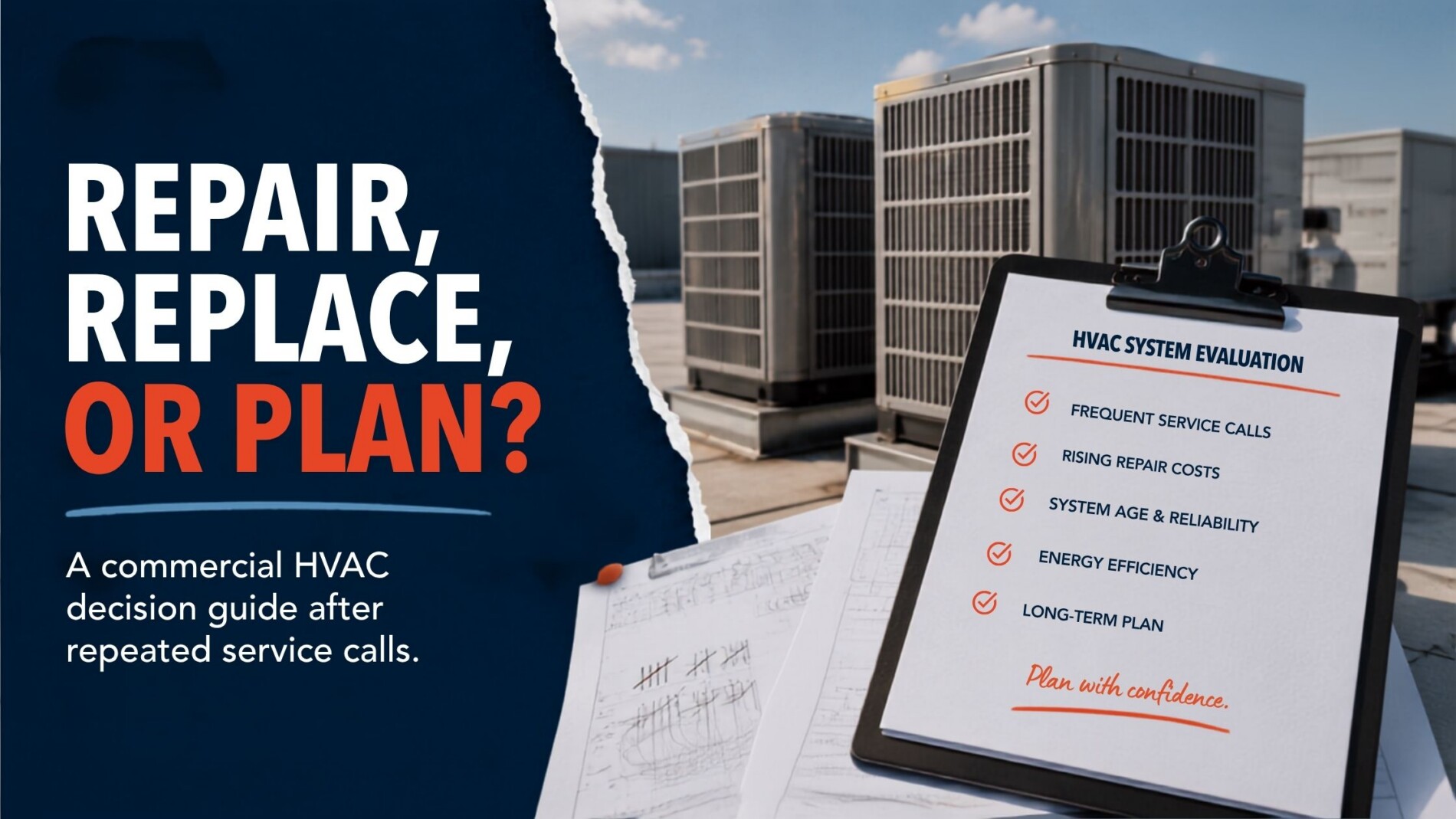
When a commercial HVAC unit stops cooling, starts leaking, loses power, or develops a problem with a compressor or condenser fan motor, the immediate concern is usually straightforward: get the system operating and reduce the disruption to the building.
Sometimes the technician can replace a failed component. Sometimes part of a multi-circuit system can be brought back online to provide temporary cooling. Sometimes the service team can identify a practical repair that keeps the unit operating while a longer-term decision is made.
The harder question comes after the immediate issue has been stabilized.
Should the facility complete another repair, begin evaluating replacement, or use the current service call as the starting point for a more deliberate plan?
There is not one answer that applies to every unit. The decision should begin with what the technician found, what the equipment can reasonably do today, how often the same system has required attention, and what the facility is likely to experience if the problem returns.
This guide is a practical starting point for facility managers, commercial building owners, property managers, school facility teams, and operations leaders who need to make that decision without treating every problem as an automatic replacement—or every repair as a permanent solution.
1. Start with what the system has already been telling you
A service call should not be evaluated in isolation when the same equipment has been creating problems throughout the season.
NTD’s service team regularly receives calls involving units that are not cooling, condensate leaks, power-related issues, compressor problems, and condenser fan motor failures. Any one of those issues may have a repairable cause, but a facility team should pay closer attention when the same unit, area, or type of problem keeps returning.
Before deciding what to do next, review the unit’s recent history. Consider how many times a technician has been dispatched, whether the problem has repeated after a prior repair, whether temporary cooling was needed, and whether the equipment has been creating ongoing complaints or interruptions for the occupants.
The purpose of this review is not to make the service history look worse than it is. It is to separate a specific, repairable event from a developing pattern.
A motor that fails once may require a motor replacement. A unit that repeatedly loses cooling, leaks into the building, or needs another temporary measure to remain operational may require a broader conversation.
Facility team question: Has this unit experienced a single identifiable failure, or has it become a recurring source of calls, disruptions, and uncertainty?
2. Understand what another repair will actually accomplish
Another repair may be the responsible decision, particularly when the technician has identified a specific failed component and the service team can explain how the repair will restore operation.
During an active service call, the immediate response may include replacing a condenser fan motor, locating the required part, or using an available circuit to provide temporary cooling while the permanent work is coordinated. The service team should then explain what happened, what can be done immediately, and what the facility should expect next.
The important distinction is whether the repair addresses the problem or merely buys time.
Buying time is not necessarily a bad decision. Temporary cooling or a targeted repair may help a facility continue operating until parts arrive, until the weather changes, or until replacement work can be scheduled more responsibly. The problem comes when a temporary measure is treated as though the larger decision has already been resolved.
A useful repair conversation should clarify whether the proposed work is expected to correct the issue, whether it is intended as a short-term bridge, and what risk remains after the work is complete.
Facility team question: Will this repair resolve the identified failure, or is it helping the facility reach a more appropriate time for the next step?
3. Account for the disruption around the equipment
The cost of a recurring HVAC problem is not limited to the mechanical contractor’s invoice.
In one situation described by NTD’s service team, recurring equipment leaks affected electrical components and lighting in office areas. The problem also led to repeated emergency calls during the day and at night, interfered with meetings, and required the customer to spend more time addressing the same issue.
That is why downtime matters in a repair-versus-replacement conversation.
Each additional trip may create another period without reliable heating or cooling. The call may happen after hours. The right technician may not be immediately available. Employees, tenants, students, customers, or building operations may need to adjust while the issue is diagnosed again.
The facility team should therefore consider the operational impact of the failure in addition to the cost of the part. A repair that appears less expensive on paper may become more difficult to justify when the unit is also creating repeat interruptions, after-hours calls, water damage, or uncertainty in an important area of the building.
Facility team question: What is this unit costing the facility in downtime, interruptions, emergency response, and repeat coordination—not only in parts and labor?
4. Know when replacement needs to enter the conversation
Replacement should enter the conversation when repairs begin to feel less like a solution and more like a way to get the equipment through one more season.
Equipment age matters, but it should be considered alongside the full service history: what is failing, how often the unit has required attention, whether parts remain practical to source, what previous repairs have accomplished, and how another breakdown would affect the building. In some cases, replacing a specific component can responsibly extend the life of the system. In others, repeated repairs may only postpone a larger decision while creating additional downtime and service costs.
The goal is not to replace equipment because it has reached an arbitrary age. It is to determine whether the unit can continue to serve the building dependably, or whether evaluating a replacement now would give the facility more control over the cost, timing, and disruption of the work.
At some point, the service conversation may need to move beyond another “band-aid” and toward equipment selection, replacement pricing, and a realistic schedule for completing the work.
Facility team question: Is the current repair restoring a dependable unit, or are repeated parts changes only extending an unreliable situation?
5. Use temporary solutions as a bridge, not the destination
Temporary cooling can be extremely valuable when a system fails at the wrong time.
A service team may be able to operate one available circuit, perform a limited repair, or create another temporary path to help the facility remain functional while parts, pricing, or replacement equipment are being coordinated.
That response gives the facility breathing room, but it should also trigger a clear follow-up plan.
The facility manager should know what remains unresolved, how long the temporary measure is expected to remain appropriate, and what decision must be made before the system is placed under another period of heavy demand.
Planning does not always mean replacing the unit immediately. It may mean approving a repair now while requesting a replacement quote. It may mean maintaining temporary operation until a better installation window. It may also mean deciding that the cost and disruption of another likely call are greater than the benefit of postponing the replacement again.
The value of planning is that the facility makes the decision while it still has options, rather than waiting for the next failure to set the schedule.
Facility team question: What needs to be decided while the temporary solution is still working and the facility has time to coordinate the next step?
6. Use preventive maintenance to improve the decision
Preventive maintenance cannot guarantee that equipment will never fail, but it can give the service team more opportunities to identify developing problems and provide the facility with better information before a failure becomes urgent.
Preventive maintenance gives technicians a structured opportunity to look beyond whether the equipment is operating at that moment. During a visit, they may change filters, check system pressures, inspect and clear drain lines, clean condenser coils, and review components such as contactors for signs of sticking. These routine checks can bring developing issues to light while there is still time to address them, before they become a no-cooling call, a leak, or another disruption to the building.
Site familiarity also matters. When technicians return to the same location and become familiar with the equipment, they are better positioned to notice when something is out of place or operating differently than it did during a previous visit.
That history strengthens the repair-versus-replacement conversation because the recommendation is not based only on what happened during one emergency call. The team can consider what has been observed over time, what has already been repaired, and whether the equipment is becoming less dependable.
Preventive maintenance may also identify issues before they affect other parts of the building. That is especially important with drain and leak problems, which can move beyond the HVAC equipment.
Facility team question: Does the facility have enough maintenance history to understand whether this problem is new, recurring, or part of a larger decline?
7. Expect a recommendation that explains the tradeoffs
Facility teams should not be left with a technical diagnosis they cannot translate into a decision.
A useful service conversation should explain what failed, whether the system can be restored, whether temporary cooling or heating is available, what another repair is expected to accomplish, and what may happen when the larger issue is postponed.
NTD’s service team brings both technical experience and an understanding of what a system problem means for the people responsible for the building. That perspective helps the team move beyond identifying what failed and focus on what the customer needs to know next: what can be repaired, what may require replacement, whether temporary operation is possible, and how each option could affect downtime and future service needs. The goal is to make the technical side of the decision clear enough for facility teams to act with confidence.
The goal should not be to force every service call toward a replacement. It should be to give the customer enough understandable information to make a responsible decision.
That may result in an approved repair. It may result in a request for replacement pricing. It may result in temporary operation paired with a planned follow-up. What matters is that everyone understands what the current work solves—and what it does not.
Facility team question: After the service conversation, do you understand the immediate fix, the remaining risk, and the next decision the facility needs to make?
The next responsible step
Not every failed component means the entire unit should be replaced, and not every unit should continue to receive repairs simply because another part can be replaced.
The responsible next step depends on the diagnosis, the recent service history, the effect on building operations, the availability of a practical repair, and the consequences of another failure.
Start with the record of what has happened. Ask what the proposed repair will accomplish. Account for the downtime and disruption around the equipment. Use temporary cooling as a bridge when it is appropriate, but establish what comes next before the temporary solution becomes the permanent operating plan.
The most useful question is not only:
Can this unit be repaired?
It is:
What is the most responsible next step for the building: repair, replacement, or a plan that connects the two?
NTD’s service team works with building owners and facility managers to evaluate preventive maintenance needs, coordinate repairs, discuss replacement options, and translate technical findings into practical next steps.


